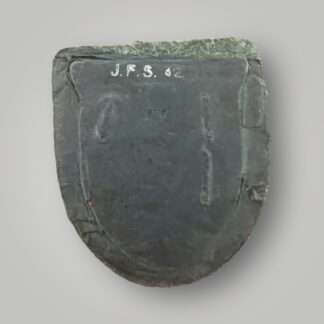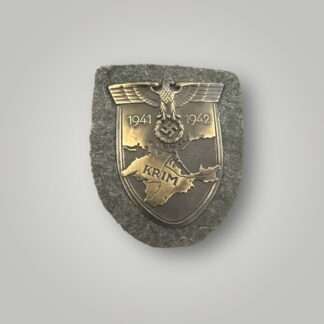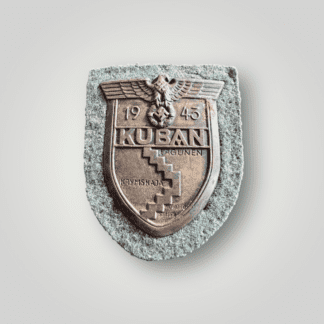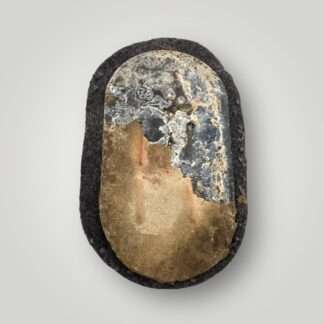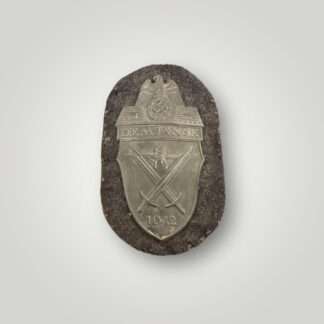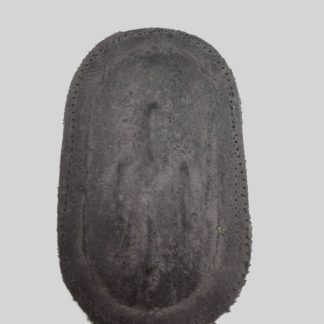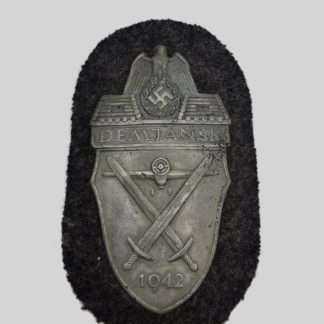



Description
Brief History Cholm Campaign Shield 1942
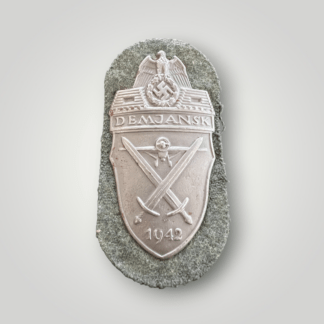
At the beginning of 1942, as the German offensive in the east began to lose momentum, the Soviet Army launched its winter counter-offensive, seeking to push German front lines back from Moscow and Leningrad. The small town of Cholm, strategically important to both the German defence and the Soviet winter offensive, was hastily fortified by an improvised force of Luftwaffe, Police, and Heer units numbering around 5,500 men. On 21 January 1942, Soviet forces surrounded the town with three full divisions, beginning a brutal siege that would become renowned for the determination and endurance of the German defenders. Throughout the encirclement, the Soviet divisions placed relentless pressure on the pocket. With almost no heavy weapons, limited ammunition, and resupply possible only by airdrop or glider, the defenders held out against repeated attacks for 105 days. On 5 May 1942, a third relief attempt finally succeeded in breaking the encirclement. The Cholm Shield was designed during the siege by Generalmajor Theodor Scherer, commander of the Cholm Pocket, together with Polizei-Rottwachtmeister Schlimmer. It was officially instituted on 1 July 1942 and awarded to those who had fought within the Cholm Pocket between 21 January and 5 May 1942.
With only around 5,500 men having served inside the pocket, the Cholm Shield is regarded as the rarest of the officially produced German campaign shields.