

Campaign Shields
WW2 German campaign shields, known in German as Ärmelschilde, were military awards worn on the upper left sleeve of the uniform. They were created to recognise personnel who had taken part in specific campaigns, battles, sieges, or defensive actions during the Second World War. Unlike many traditional medals, these awards were not worn from a ribbon or pinned to the tunic breast, but were mounted on cloth backings and sewn directly to the uniform sleeve. This gave them a very distinctive appearance and made them immediately associated with a particular theatre of war.
The campaign shield system reflected the German military’s desire to commemorate individual service in demanding and often highly symbolic operations. Some shields were awarded for large-scale campaigns involving tens or hundreds of thousands of men, while others recognised relatively small groups who had endured exceptionally difficult battlefield conditions. As a result, the rarity and desirability of original examples can vary greatly, depending on the shield, the branch of service, construction type, backing cloth, and surviving condition.
The Narvik Shield
The Narvik Shield was the first of the official campaign shields and was instituted in 1940 for personnel who took part in the fighting around Narvik in Norway. The design incorporated symbols representing the three services involved: the edelweiss for mountain troops, the anchor for the Kriegsmarine, and the propeller for the Luftwaffe. It was produced in different finishes, with silver examples for the Heer and Luftwaffe and gilt examples for the Kriegsmarine. Because of its early date, attractive design, and relatively limited award numbers, the Narvik Shield remains one of the most recognisable and sought-after campaign shields among collectors.
The Cholm Shield
The Cholm Shield was awarded for service in the Cholm Pocket during 1942, one of the most intense defensive battles on the Eastern Front. It is among the rarest of the officially awarded German campaign shields, with a much smaller award total than the Crimea, Demyansk, or Kuban Shields. Its design is simple but powerful, usually featuring an eagle and the inscription “CHOLM 1942”. Original examples are highly prized, particularly when found with their correct backing cloth, paper covering, or evidence of period uniform removal.
The Crimea Shield
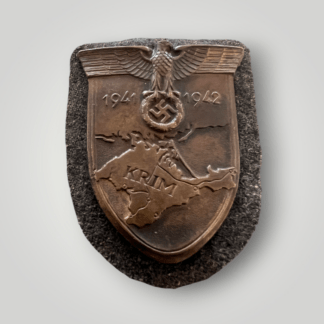
The Crimea Shield, or Krimschild, was instituted in 1942 for members of the German and allied forces who served in the Crimean campaign, including operations leading to the capture of Sevastopol. It is one of the most commonly encountered campaign shields due to the large number awarded. The design typically shows a map outline of Crimea, the dates of the campaign, and the national eagle above. Despite being more available than some other shields, original examples remain popular because of the shield’s strong visual design and connection to a major Eastern Front campaign.
The Demyansk and Kuban Shields
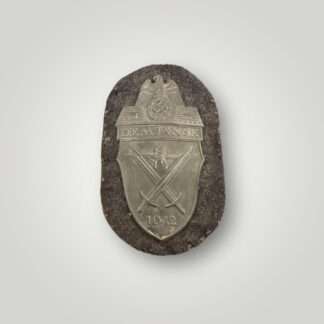
The Demyansk Shield was created to recognise those who had served in the Demyansk Pocket, another major defensive action on the Eastern Front. Awarded to members of the Heer, Luftwaffe, and Waffen-SS, it commemorated a hard-fought encirclement battle in difficult terrain and severe weather. The Kuban Shield followed in 1943 and was awarded for participation in the fighting around the Kuban bridgehead. Both shields are important Eastern Front awards and are widely collected, with variations in metal, finish, backing cloth, and attachment style all influencing desirability.
The Lapland and Warsaw Shields
The Lapland Shield was associated with service in northern Finland during the final phase of the war. Unlike earlier awards, it is often treated differently by collectors because of its late-war and locally produced nature. The Warsaw Shield was authorised for those involved in the suppression of the Warsaw Uprising, but it was not produced and awarded in the normal way before the end of the war. As a result, collectors distinguish carefully between officially awarded shields, late-war locally produced pieces, and post-war or fantasy examples.
Construction and Collecting Points
Most campaign shields were die-struck from thin metal and mounted on a cloth backing matching the recipient’s service branch. Heer examples are generally found on field-grey cloth, Luftwaffe examples on blue-grey cloth, and Kriegsmarine examples on navy-blue cloth. The reverse construction can include metal prongs, a backing plate, paper covering, or evidence that the shield was once sewn to a uniform. Condition is especially important: sharp detail, original finish, untouched backing cloth, intact prongs, and genuine age patina are all valued by collectors.
Because campaign shields have been heavily reproduced, careful authentication is essential. Collectors should consider the shield’s dimensions, weight, metal composition, die characteristics, finish, prong style, cloth backing, and provenance. Some reproductions can be convincing at first glance, but often lack the correct detail, ageing, or construction methods seen on original wartime examples. Comparison with known originals and reference material is particularly important when assessing rarer shields such as Cholm or Narvik.
Historical Interest
Today, WW2 German campaign shields are collected not only as militaria but also as physical reminders of specific campaigns and battlefield experiences. Each shield tells a story about where a soldier served, the conditions he faced, and how the German military chose to recognise that service. From the cold mountains of Norway to the encirclements of the Eastern Front and the final battles in northern Europe, campaign shields represent some of the most distinctive uniform awards of the Second World War. For collectors, original examples combine historical significance, visual appeal, and the challenge of correct identification, making them an important and fascinating area within German military collecting.
Showing all 6 results
-


Heer (Army) Narvik Campaign Shield Mountain Troops
This attractive Heer (Army) Narvik Campaign Shield for Mountain Troops, constructed in zinc on light green woollen backing. The front of the shield is very striking with a nice silver wash and nice patina. On the reverse, all four prongs are visible, the backing plate, and the paper backing remain intact. The shield is free from damage or repairs and, being in mint condition, would be difficult to upgrade.
Product ID: 18355 £700.00View Details Add to Basket -
Heer Demjansk Campaign Shield
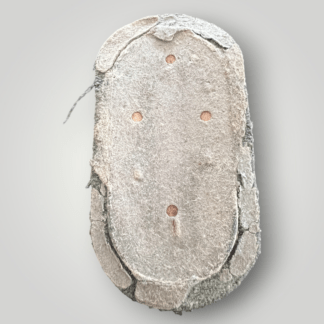
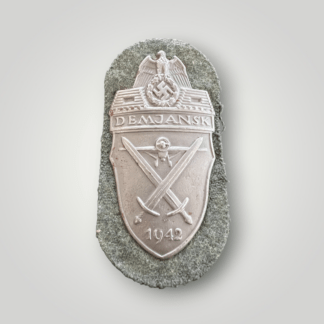
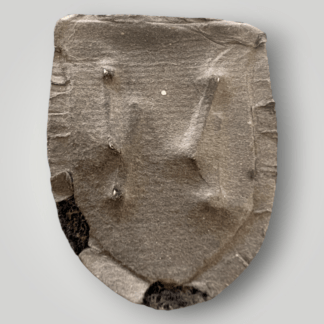
An original Heer Demjansk shield, die-struck with silver wash. The obverse depicts the national eagle clutching a wreathed mobile swastika, with a log pillbox on either side, with the inscription above “DEMJANSK”, with a frontal image of a prop plane below, with crossed swords with the date below “1942”, mounted on field-grey woolen background. The reverse has a steel backing plate with paper backing, The campaign shield has no damage or repairs in very good condition.
Product ID: 19138 £485.00View Details Add to Basket -
Heer Krim Campaign Shield
An original Heer Krim Campaign Shield, constructed in pressed steel, magnetic, with a bronze finish. The obverse of the decortaion depicts a raised map of Crimea and southern Ukraine, topped by a Wehrmacht-style German national eagle clutching a wreathed mobile swastika, flanked by dates “1941-1942”, affixed to a field-grey wool patch. The reverse of the campaign sheild including the backing plate with all prongs intact, with paper backing on field-grey wollen backing. The
Product ID: 19134 £265.00View Details Add to Basket -
Top
Luftwaffe Cholm Campaign Shield 1942 – Rare
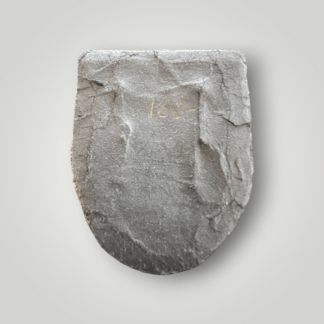
An original Luftwaffe Cholm Campaign Shield 1942, die stamped construction in zinc on grey woollen backing. The obverse of the campaign shield depicts a large open winged Wehrmacht eagle clutching a Iron Cross with a Swastika in the centre. Below this is embossed “CHOLM 1942”. The shield is unmarked but known as a “Short M” variant due to the short angle of the middle section. The reverse of the shield has all the prongs intact complete with backing plate and paper. The shield has no damage or repairs with nice patina with minor signs of age. Overall, a very rare combat award a great addition for any collection.
Product ID: 19157 £3,650.00View Details Add to Basket -
Luftwaffe Demjansk Campaign Shield
An original Luftwaffe Demjansk shield unmarked, die-struck with silver wash. The obverse depicts the national eagle clutching a wreathed mobile swastika, with a log pillbox on either side, with the inscription above “DEMJANSK”, with a frontal image of a prop plane below, with crossed swords with the date below “1942”, mounted on blue-grey woolen background. The reverse has all prongs intact, with paper backing and measures 92.2mm (h) x 51.1 mm (w). The campaign shield has no damage or repairs in very good condition.
Product ID: 10666 £585.00View Details Add to Basket -
Luftwaffe Krim Campaign Shield
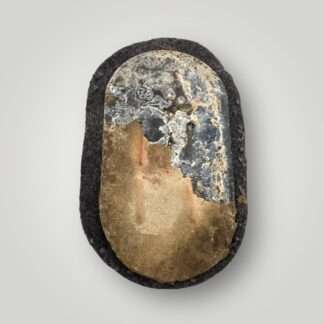
An original Luftwaffe Krim Campaign Shield magnetic version with bronze finish with beautiful patina, mounted on Luftwaffe blue-grey fabric. The reverse of the shield is complete with prongs and papper backing. The has no damage or repairs in good condition.
Product ID: 19444 £265.00View Details Add to Basket



Showing all 6 results